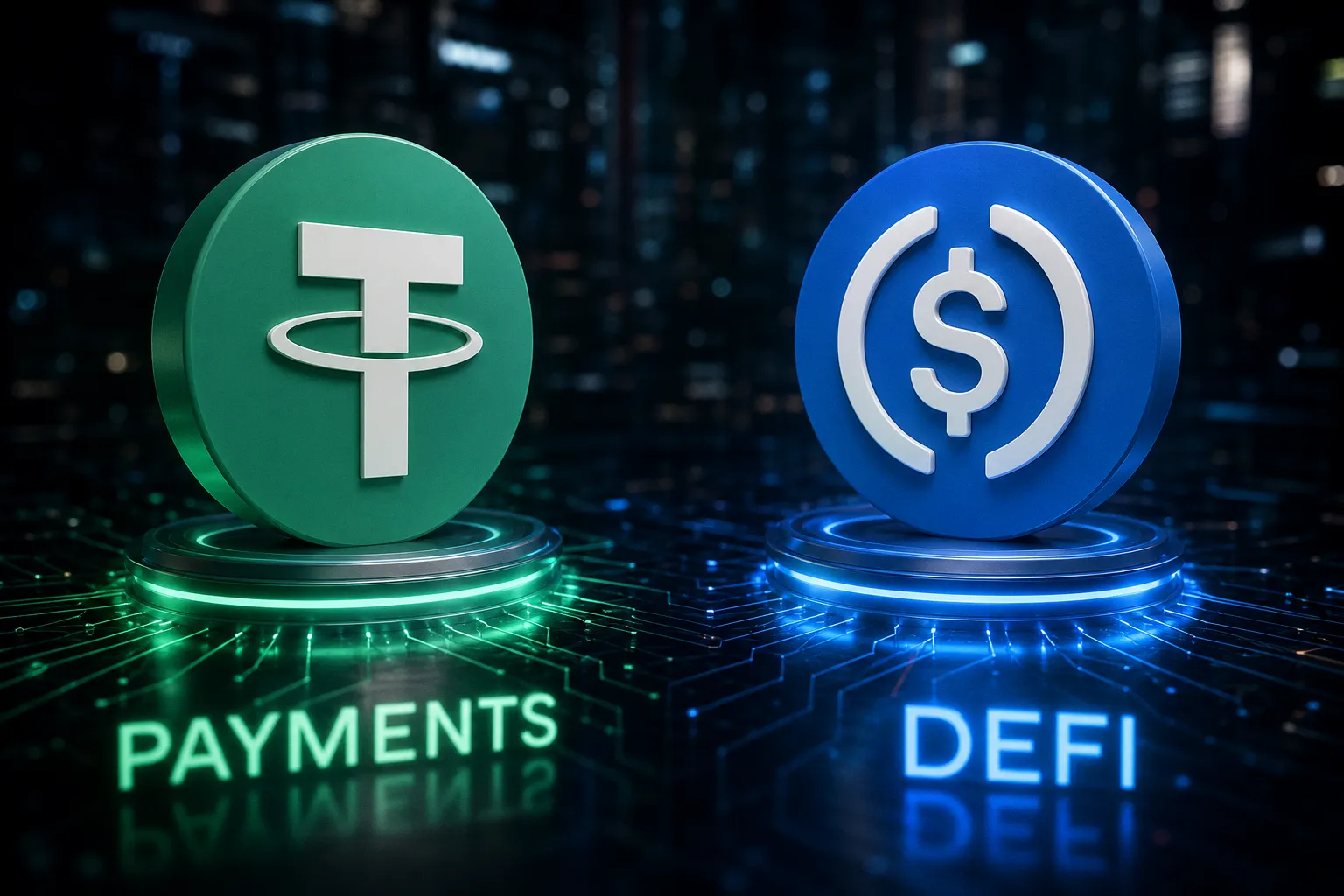
USDT leads stablecoin payments with $95B, while USDC dominates DeFi, signaling market specialization.
USDT processed roughly $95 billion in commercial payments in H1 2026. That’s not a typo. While the crypto world obsesses over the next shiny L1 or meme coin launch, the stablecoin market has quietly split into two distinct, monolithic roles.
Cameron Walton, Tokenomics Veteran & Launchpad Critic·updated July 09, 2026
The Specialization Is Now Undeniable
The data from Dune cuts through the "USDT vs. USDC" narrative. They aren't competing; they're serving completely different masters. USDT, overwhelmingly domiciled on Tron (where ~93% of its supply sits in non-exchange wallets), has become the settlement rail for real-world payments and remittances. It accounted for 92% of the $480 billion in B2B stablecoin payments in the first half of the year. This isn't DeFi liquidity; it's global, off-exchange value transfer. USDC, meanwhile, is the lifeblood of on-chain finance. Its cumulative transfer volume hit $2.6 trillion on Base and $1.6 trillion on Ethereum. It's the primary collateral, the main trading pair, the programmable dollar for protocols. Together, they command 83% of the $315 billion stablecoin market. The market didn't crown a winner; it assigned them jobs.
Launchpad Liquidity Has a Clearer Blueprint Now
For any project launching a token, this split dictates where your liquidity will actually come from and how it will behave. Need to bootstrap trading volume and integrate with lending protocols? You're building on a USDC foundation. Its deep DeFi integration is non-negotiable for serious protocol utility. Are you targeting a global user base with a payment or remittance feature in your ecosystem? Then USDT liquidity, particularly on Tron, is your primary channel. A launchpad that understands this won't pitch a "one stablecoin fits all" strategy. They'll help you align your initial liquidity pools and DEX incentives with the stablecoin whose user base matches your token's intended function. Pumping a USDC-only pool for a payments-focused token is a rookie mistake with quantifiable consequences.
What This Actually Means for Your Capital
Stop thinking of stablecoins as a homogeneous "cash" sideline. They are now specialized tools. USDT is your global, high-velocity payment rail. USDC is your institutional-grade, DeFi-native collateral. The maturation here is bullish for the ecosystem—it creates clearer, more efficient pathways for liquidity. For retail participants, this means paying closer attention to which stablecoin is dominant on the chain and within the dApps relevant to your investment thesis. If the launchpad or project you're evaluating can't articulate why they're choosing one stablecoin over the other for core functions, they haven't done their homework. In a market moving toward specialization, generic tokenomics are a red flag.